

No calculator allowed: 7 math shortcuts for the Civil Service Exam (with step-by-step solutions)
Here is the rude surprise in Numerical Ability: calculators are not allowed. Not a phone, not a watch, nothing. So the people who finish are not the ones who are best at math. They are the ones who know a few Civil Service Exam math shortcuts and do not compute more than they have to. Here are seven.
- Why the long way loses, even when it is right
- 1. Build every percent from 10%
- 2. Find what is left, not what is taken away
- 3. Round first, then correct
- 4. Let the choices do the work
- 5. Put it in a small table
- 6. Put negative numbers in parentheses
- 7. In ratio problems, find one part first
- Shortcuts are not "do it in your head"
- A good solution shows you all of this
- Practice them until they are automatic
- FAQ
Why the long way loses, even when it is right
You have about a minute per item. A word problem solved the textbook way, with long multiplication and long division written out, can easily take three. Do that ten times and you have borrowed twenty minutes from questions you could have answered.
The person who built ReviewTayo had all three math problems at once on his earlier attempts. Some items he could solve, but slowly. Some he did not know how to start. And on the ones he did know, he slipped on signs and decimals because he was rushing to make up time.
The reviewers did not help much. Sometimes the solution was only a letter. Sometimes it was one line of formula with no steps. Sometimes it was a full, correct solution done the slowest possible way. None of them showed the quick route. These seven do.
1. Build every percent from 10%
Ten percent is just the number with the decimal point moved one place left. From there, everything else is halving, doubling and adding.
What is 15% of ₱2,400?
10% is 240. Half of that, 5%, is 120. Add them: ₱360.
Same idea for 35% of 80: 10% is 8, so 30% is 24 and 5% is 4. Total 28. No multiplication by 0.35 needed.


2. Find what is left, not what is taken away
When a price drops by 20%, you keep 80%. Go straight to the 80% and skip the subtraction.
A ₱1,500 item is 20% off. What is the sale price?
10% is 150, so 80% is 150 × 8 = ₱1,200. One step, and one less place to make a mistake.
This matters most when there are two discounts in a row. We solved that one in full in the "25% off plus 10% off" trap.
3. Round first, then correct
Ugly numbers are usually one step away from friendly ones.
398 × 21 = ?
A. 7,358 B. 8,358 C. 8,538 D. 9,358 E. 8,058
Treat 398 as 400. Then 400 × 21 = 8,400. You added two extra 21s, so take 42 back: 8,400 − 42 = 8,358, choice B.
Even before the correction, the estimate of 8,400 already tells you A and D are impossible. Often an estimate alone is enough to pick the answer.
4. Let the choices do the work
The answer is on the page. Sometimes it is faster to test the choices than to build an equation.
The sum of three consecutive even numbers is 78. What is the largest of the three?
A. 24 B. 26 C. 28 D. 30 E. 32
Start with the middle choice. If the largest is 28, the numbers are 24, 26 and 28, and they add up to 78. Done: C.
There is an even quicker route here. Three evenly spaced numbers average to the middle one, and 78 ÷ 3 = 26. So the numbers are 24, 26 and 28. Note that 26 is sitting in the choices as bait for people who stop one step early.
5. Put it in a small table
Age, work and distance problems feel hard because the sentence hides the structure. A two-row table shows it.
Ana is 4 years older than Ben. In 6 years, the sum of their ages will be 40. How old is Ben now?
| Now | In 6 years | |
|---|---|---|
| Ben | B | B + 6 |
| Ana | B + 4 | B + 10 |
| Together | 2B + 4 | 2B + 16 = 40 |
From the last cell, 2B = 24, so Ben is 12 and Ana is 16. Check: in 6 years they are 18 and 22, which is 40.
The table took ten seconds to draw and it wrote the equation for you.
6. Put negative numbers in parentheses
Most sign mistakes are not about math. They happen because a minus sign got lost on the way down the page.
If y = −2, what is y³ − y?
The choices: −10, −8, −6, −4, 10
Write the substitution with parentheses: (−2)³ − (−2).
(−2)³ is (−2)(−2)(−2) = −8. An odd power of a negative number stays negative. Then subtracting −2 is the same as adding 2, so −8 + 2 = −6.
This is a real question from ReviewTayo, so here is the actual explanation you get in the app. In this picture the sign-slip answer, −10, was picked on purpose.


Every wrong choice is on the list for a reason, and the app names each one:
- −10: sign slip on subtraction. −8 − 2 subtracts 2. Subtracting y = −2 means −8 + 2.
- −8: stopped early. (−2)³ = −8 is only y³. The y has not been subtracted yet.
- −4: exponent read as multiplication. y³ was taken as 3y: 3(−2) − (−2) = −4.
- 10: wrong power sign. (−2)³ was taken as +8, so 8 + 2 = 10.
Four wrong answers, four different mistakes. If you know which one you made, you know exactly what to fix.
7. In ratio problems, find one part first
₱12,000 is divided among three people in the ratio 2 : 3 : 5. How much is the largest share?
Add the ratio: 2 + 3 + 5 = 10 parts. One part is 12,000 ÷ 10 = 1,200. The largest share is 5 parts: ₱6,000.
Once you know one part, every share is a single multiplication. The lesson preview on ratio and proportion has more of these.
Shortcuts are not "do it in your head"
A shortcut removes steps. It does not remove writing. The fastest examinees still write, because one line on paper is cheaper than redoing an item you got wrong in your head.
In the exam you do your computations by hand in the test booklet, so practice the same way. Take this one.
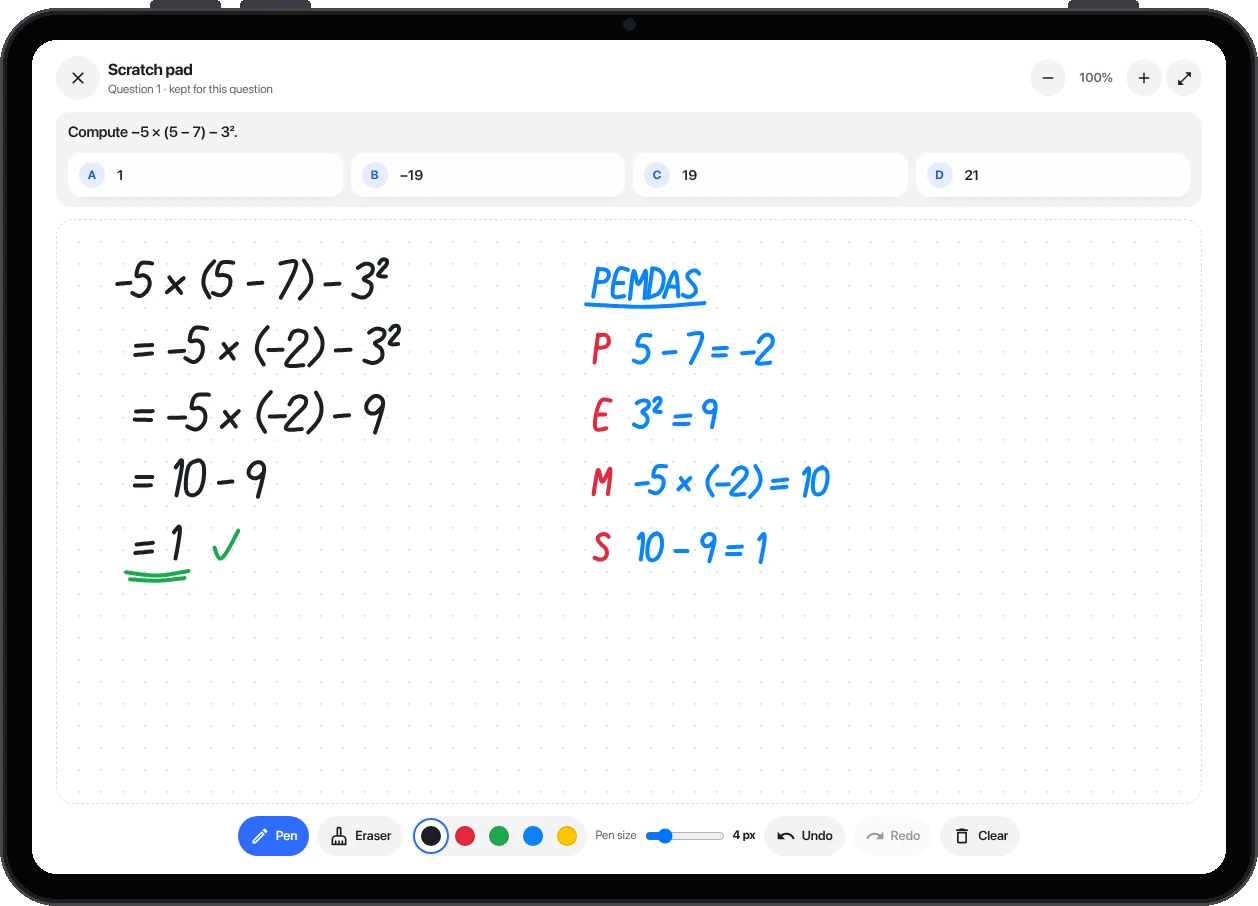
Compute −5 × (5 − 7) − 3².
A. 1 B. −19 C. 19 D. 21
Four short lines, in PEMDAS order, and there is nothing left to get wrong.
- Parentheses: 5 − 7 = −2
- Exponents: 3² = 9
- Multiply: −5 × (−2) = 10
- Subtract: 10 − 9 = 1, choice A
Try it in your head and you will meet −19 or 19 very quickly. Both are on the list.
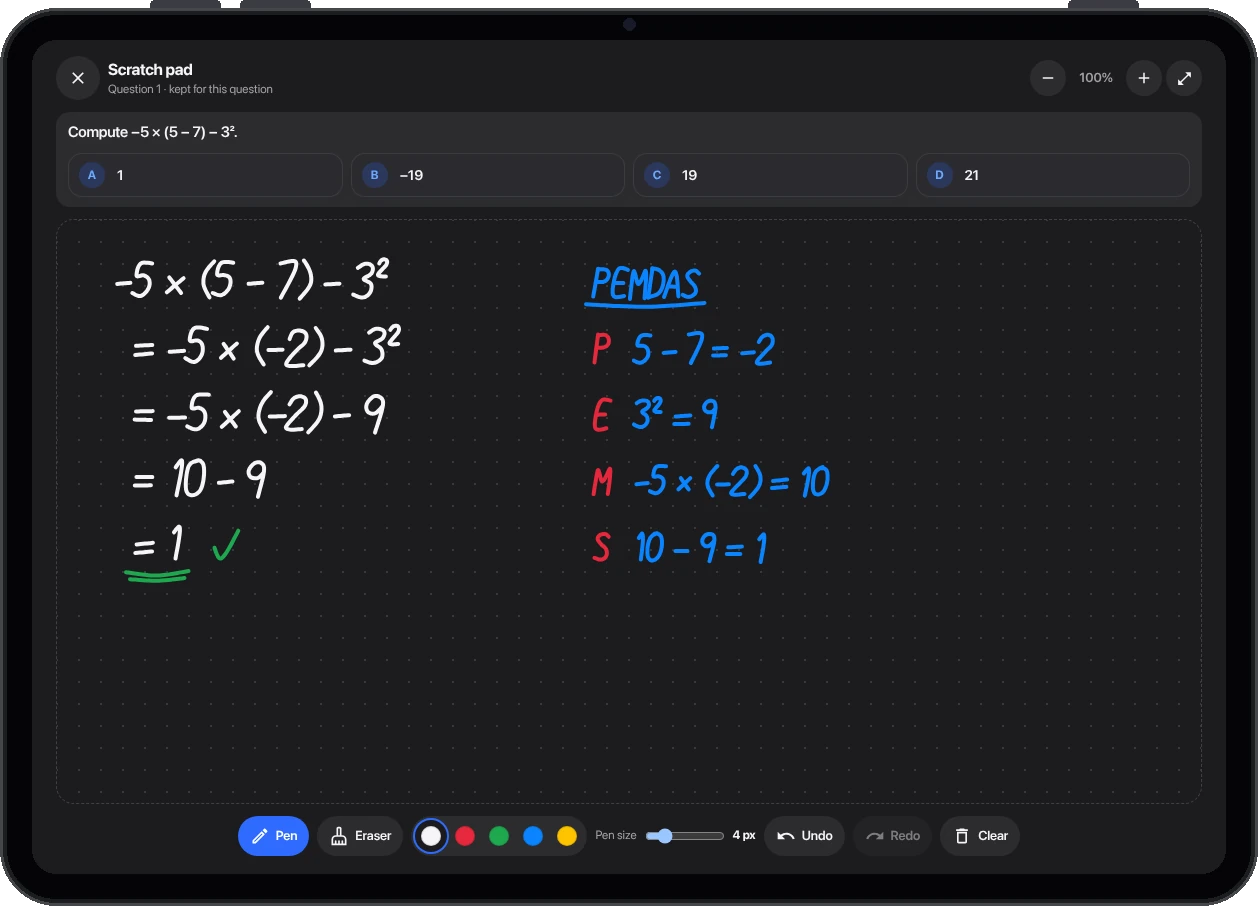
ReviewTayo has a scratch pad on every question for this reason. You solve it the way you would on paper, without leaving the question: pens in different colours, an eraser, undo and redo, and zoom for long solutions. It works in practice and in mock exams, with your finger, a stylus or an Apple Pencil, and your work stays with that question.
A good solution shows you all of this
Notice what each example above gave you: the answer, the steps, the faster route, and why the wrong choices were on the list. That is what an explanation is supposed to do. A letter in an answer key does none of it.
It is how every practice question in ReviewTayo is explained. Right after you answer, you see the right choice, why yours was wrong, and a step-by-step solution, with a drawing, diagram, table or chart where it helps, and the shortcut when there is one.


Shortcuts only work on top of the basics, so if signed numbers or fractions still feel shaky, start there: signed numbers and the order of operations and percent. For how to use explanations in your review, see is the exam hard?
Practice them until they are automatic
Reading a shortcut once does not make you fast. Use each one on ten questions this week, with a timer, and it becomes the way you think.
Every new ReviewTayo account gets 3 days of full access to try everything. After that it is a one-time payment from ₱99, with no subscription. Create your account and start a Numerical set. Tara, Review Tayo!
Frequently asked questions
Are calculators allowed in the Civil Service Exam?
No. Calculators, including watch calculators, phones and smartwatches are not allowed in the testing room, so every Numerical Ability item has to be solved by hand.
How can I solve Civil Service Exam math faster?
Compute less. Build percents from 10 percent, round numbers before multiplying, test the answer choices, put word problems in a small table and keep negative numbers in parentheses. Then practice with a timer.
What math topics are in the Civil Service Exam?
Numerical Ability covers basic operations, number sequences and word problems. That includes fractions, decimals, percent, ratio and proportion, and basic algebra.
Is scratch paper allowed in the Civil Service Exam?
Separate scratch paper is not allowed. You do your computations by hand in the test booklet. Follow the instructions of your room examiner and the CSC advisory for your exam.
How do I avoid careless mistakes in math?
Write negative numbers in parentheses, estimate the answer before computing, and check that your result is a sensible size. Most careless errors are dropped signs and misplaced decimals.
Do I need to memorize formulas for the Civil Service Exam?
A few basics help, such as percent, ratio, average and distance-rate-time. Understanding how each works matters more than memorizing, because the questions change the details.
Keep reading
Successive discount problems with solutions: the "25% off plus 10% off" trap
A worked Civil Service Exam math question on successive discounts: why 25% off plus 10% off is not 35% off, the one-line shortcut without a calculator, and three more to try with answers.
Worked examplesNumber series in the Civil Service Exam: the patterns that solve most items, with worked answers
Number series in the Civil Service Exam follow a small set of patterns. Learn the 8 most common ones, a 3-step method to spot them fast, and try 6 practice items with worked answers.
Worked examplesCivil Service Exam grammar: the errors that cost the most points and how to spot them
Civil Service Exam grammar comes down to a short list of errors. Learn the 8 that appear across the most item types, a quick check for each, and try 8 identifying-error items with answers.