

Is the Civil Service Exam hard? Answer these 6 questions before you decide
People will tell you two different things. "Madali lang, parang high school." And: "Three takes na ako." So, is the Civil Service Exam hard? Do not take anybody's word for it. Here are six questions. Answer them, then we will talk.
Six questions, no time limit (for now)
One or two from each subject. Pick an answer before you open the solution. Walang daya.
1. Each of the applicants ______ submitted the requirements.
A. have B. has C. are D. were E. having
Show the answer
B. has. The subject is each, which is singular. Applicants is only part of the phrase "of the applicants", and it is placed right before the blank to pull you toward "have".
2. The auditor's report was candid about the agency's lapses. Candid most nearly means:
A. harsh B. frank C. secret D. brief E. careful
Show the answer
B. frank. Candid means honest and direct. "Harsh" is the trap: a candid report can feel harsh, but the word is about honesty, not severity.
3. A clerk can encode 45 forms in 30 minutes. At the same rate, how many forms can she encode in 2 hours?
A. 90 B. 135 C. 150 D. 180 E. 270
Show the answer
D. 180. Two hours is four 30-minute blocks, and 45 × 4 = 180. Choice A is one hour and choice B is an hour and a half. They are there for people who convert the time wrong.
4. What number comes next? 3, 6, 11, 18, 27, ____
A. 36 B. 37 C. 38 D. 39 E. 40
Show the answer
C. 38. The gaps are 3, 5, 7 and 9, so the next gap is 11, and 27 + 11 = 38.
5. All supervisors attended the training. Some of those who attended the training received certificates. Which of the following must be true?
A. All supervisors received certificates.
B. Some supervisors received certificates.
C. No supervisor received a certificate.
D. Everyone who received a certificate is a supervisor.
E. None of the above must be true.
Show the answer
E. None of the above must be true. The people who received certificates may all have been non-supervisors who also attended. B feels right, and that is exactly why it is on the list. "Could be true" and "must be true" are different questions.
6. Under R.A. 6713, public officials and employees must respond to letters and requests from the public within how many working days from receipt?
A. 3 B. 5 C. 10 D. 15 E. 30
Show the answer
D. 15 working days. It is in Section 5(a) of the Code of Conduct and Ethical Standards for Public Officials and Employees. You either know this one or you do not, which is its own kind of hard.
So, how did you do?
If you got five or six, good. If you got three, also normal. Number 5 alone catches most people.
Here is the thing, though. You just answered six questions in a quiet moment, at your own speed, with nothing at stake. None of them needed anything beyond high school. So the people who say "madali lang" are not lying. Item by item, the exam is fair.
Now answer 150 graded items like those, one after another, with a proctor watching and about a minute for each.
What actually makes the Civil Service Exam hard
In March 2026, 48,735 passed out of 307,489 examinees, or 15.85%. In August 2026 the reported rate was 14.41%. That is about 1 in 7. The questions did not do that. These did.
- The clock. Professional is 170 items in 3 hours 10 minutes, about 67 seconds each. There is no time to argue with yourself.
- Choices that all look right. As in number 5, the wrong answers are written to match the mistake you are most likely to make.
- Switching gears. Grammar, then fractions, then logic, then the Constitution. Your brain has to change subjects again and again without a warm-up.
- Three hours of focus. Item 140 is not harder than item 14. You are just more tired when you meet it.
- Knowing is not the same as doing. You can understand a topic and still be slow at it. Speed is a skill, and reading does not train it.
Which part is toughest? It depends on you, but there is a clue from the CSC itself. After the November 2009 exam, a CSC official told The Philippine Star that Professional examinees struggled most with the analytical part, and Sub-Professional examinees with the numerical part.
One piece of good news: there is no curve. Everyone who reaches a general rating of 80.00 passes, however many that is. See passing score and results.
The mistake: practicing with an answer key only
The person who built ReviewTayo did practice before his exams. Some questions, checked against an answer key. Tama, mali, next.
What that trained was checking. It did not train solving. He knew which items he got wrong and never found out why, so word problems, logic items and the laws stayed exactly as hard as they were on day one. Nothing was ever timed, either. Then exam day asked for skills that the whole review period had never practiced.
He took the exam twice without passing. If that sounds like your review so far, the fix is not more questions. It is a different way of answering them. We wrote about the memorizing side of this in do exam questions repeat?
Practice that makes the exam easier
- Short sets, often. Ten or twenty questions a day does more than two hundred on one Sunday.
- Feedback right away, with the reason. You should learn why the right choice is right and why yours was wrong while you still remember what you were thinking.
- Your weak topics first. Answering what you are already good at feels great and changes nothing.
- Bring back your mistakes. A question you missed last week is the most valuable one you own.
- Add the clock early. Time yourself long before the mock exams, so one item a minute becomes normal.
How this works in ReviewTayo
There are more than 5,000 original practice questions across Verbal, Numerical, Analytical, Clerical and General Information, each with a step-by-step explanation. You can drill any subject or topic in short sets, or use Smart practice, which picks the topics you need most. Every question has a timer, and you can save or flag an item to come back to it, work it out on a scratch pad, or ask a friend.
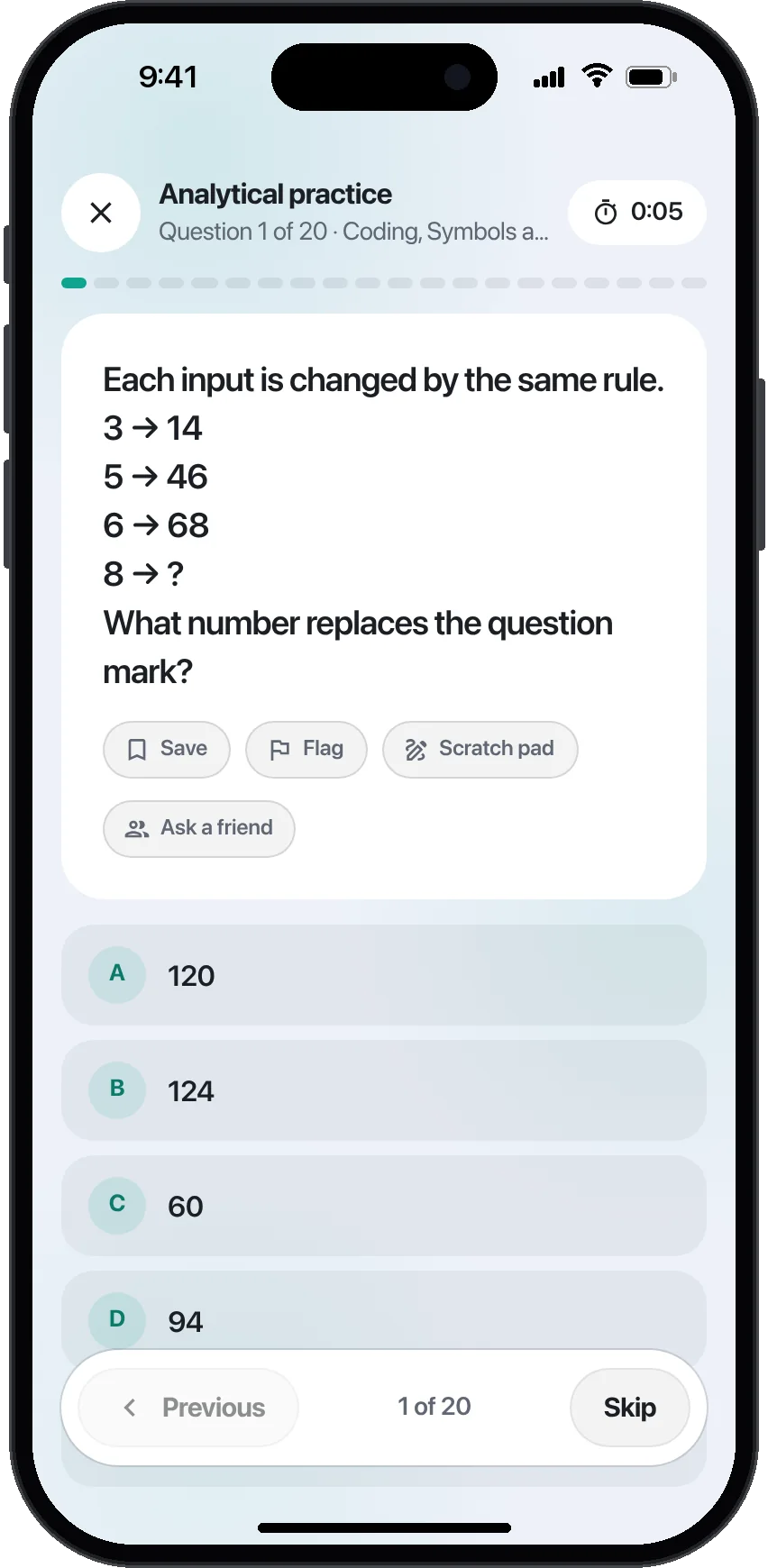
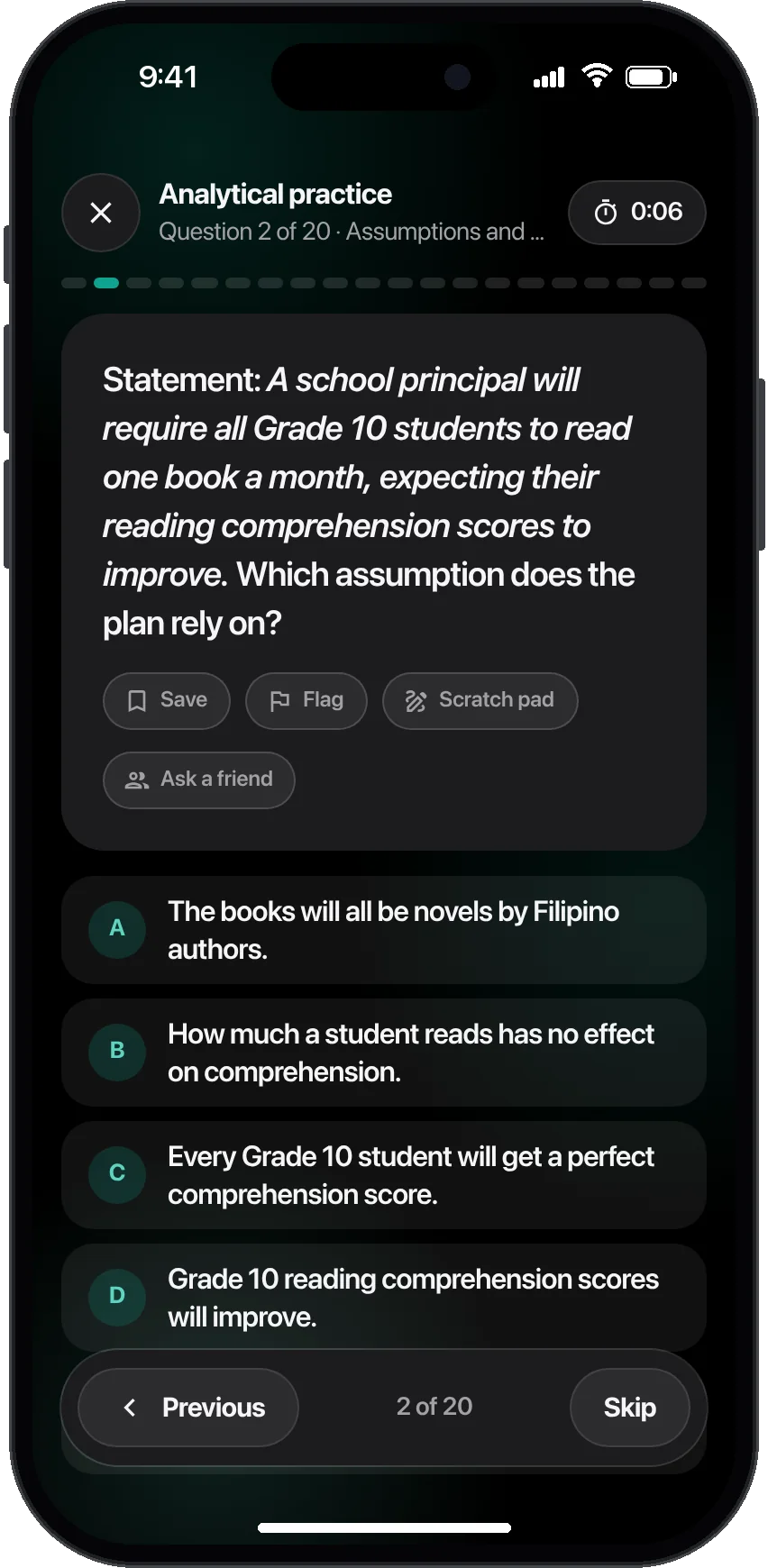
Want more to try right now? Our sample questions have 20 with answers, and the diagnostic test shows your score for each subject. For how much time to set aside, see how long to review.
The honest verdict
The Civil Service Exam is hard to pass and not that hard to prepare for. Most of the difficulty is pace, traps and stamina, and all three respond to practice.
Every new ReviewTayo account gets 3 days of full access to try everything. After that it is a one-time payment from ₱99, with no subscription. Create your account and answer your first ten. Tara, Review Tayo!
Frequently asked questions
Is the Civil Service Exam hard?
The individual questions are at about a high school level, but the exam is hard to pass. Around 15 percent of examinees passed in 2026, mostly because of the time limit, tricky answer choices, the range of subjects and the three-hour length.
What is the passing rate of the Civil Service Exam?
In March 2026, 48,735 of 307,489 examinees passed, or 15.85 percent. In August 2026 the reported passing rate was 14.41 percent.
What is the hardest part of the Civil Service Exam?
It differs per person. A CSC official said after the November 2009 exam that Professional examinees had the most difficulty with the analytical part and Sub-Professional examinees with the numerical part.
How many items is the Civil Service Exam and how long is it?
The Professional level has 170 items in 3 hours 10 minutes. The Sub-Professional level has 165 items in 2 hours 40 minutes. The first 20 items of each are a background questionnaire that is not graded.
Is the Professional level harder than the Sub-Professional?
Professional is longer and includes Analytical Ability, which many examinees find difficult. Sub-Professional has Clerical Ability instead. Both need a general rating of 80.00 to pass.
Can I pass the Civil Service Exam on my first take?
Many examinees do. There is no curve, so everyone who reaches 80.00 passes. Steady review and timed practice improve your chances, but no reviewer can guarantee a passing rating.
Keep reading
How to review for the Civil Service Exam while working: a 30-minute daily plan
A realistic Civil Service Exam study plan for people with full-time jobs: 30 minutes on weekdays, one timed session on weekends, and what to study in each of the four months before exam day.
Study tipsWhat to study first for the Civil Service Exam (read this before you buy another PDF)
You have the official scope, a folder of reviewer PDFs and no idea where to begin. Here is what to study first for the Civil Service Exam, how to check if a reviewer is even current, and a clear order to follow.
Study tipsDo Civil Service Exam questions repeat? The honest answer, and why memorizing your reviewer fails
Do Civil Service Exam questions repeat from past exams and reviewers? What actually comes back, why memorized answers collapse when one detail changes, and how to learn the rules that answer every version.