

Do Civil Service Exam questions repeat? The honest answer, and why memorizing your reviewer fails
Everybody reviewing asks it sooner or later: do Civil Service Exam questions repeat? Because if they do, the plan is easy. Memorize the reviewer, recognize the questions, go home eligible. Sorry in advance. Here is the honest answer, and a better plan.
The short answer
Do not count on it. The CSC does not release its past exam papers or answer keys, so nobody outside the Commission can truthfully tell you which items come back.
What does repeat is the scope. Every exam is built on the subjects and topics the CSC announces, so the same kinds of questions return again and again: error recognition, number sequences, word analogies, the Constitution. The topic is the same. The sentence, the numbers and the choices are not.
So a reviewer question is useful as practice for a type. It is close to useless as something to recognize on exam day.
If someone sells "actual exam questions", that is your cue to leave. Having or using exam materials from an unauthorized source is cheating under Republic Act No. 9416, with prison time and a fine, and it can bar you from government service. It is also, almost always, just an old reviewer with a bolder title.
Why memorizing feels like studying
Memorizing is comfortable. You read a question, you read the answer, you nod. After two hundred of those you feel ready, because everything on the page looks familiar.
The person who built ReviewTayo reviewed exactly this way. Memorizing questions and answers was his main method. On exam day, a few items did look familiar. The rest were the same types he had seen, wearing different clothes: other numbers, other sentences, other choices. Recognizing the costume did not help him get the answer.
It is like memorizing the lyrics to one song, and then the videoke plays a different song by the same band. Kilala mo ang boses. Hindi mo alam ang susunod na linya.
He took the exam twice without passing. The lesson he took from it is the reason this reviewer exists: familiar is not the same as understood.
One rule beats fifty memorized answers
Let us prove it with one topic from Verbal Ability. Suppose your reviewer had this item, and you memorized the fix.
The new clerk is expected to answer calls, sorting the mail, and the filing of reports.
Fix: The new clerk is expected to answer calls, sort the mail, and file reports.
Good. Now the exam gives you these instead.
- The supervisor asked us to arrive early, to bring our IDs, and that we should wear the uniform.
- She enjoys drafting memos, to read reports, and attending meetings.
- The training was long, tiring, and it cost a lot.
Your memorized answer is no help with any of them. But one small rule answers all three, and the original too.
Parallel structure: same job, same form. When items in a list do the same job in the sentence, they must take the same form.
- to arrive early, to bring our IDs, and to wear the uniform
- drafting memos, reading reports, and attending meetings
- long, tiring, and expensive
Four questions, one rule, nothing memorized. That is the trade you want everywhere in this exam. You can preview the full lesson here: Parallel Structure, Modifiers and Comparisons.
It is the same story in every subject
| Subject | What memorizing gives you | What the rule gives you |
|---|---|---|
| Grammar and error spotting | A sentence that "sounds right" | A reason it is right or wrong, even when it sounds fine |
| Math word problems | One solved example | A method that survives new numbers, like multiply what is left for discounts |
| Logic and analogies | Nothing. There is nothing to memorize | The habit of naming the relationship before looking at the choices |
| Laws and the Constitution | A pile of loose facts that fade in a week | A structure to hang the facts on, so they stay |
One fair warning about that last row. General Information does need memory. You cannot reason your way to the number of senators. But memory works far better when the facts are organized: who does what, in which branch, under which article. Memorize a map, not a list.
How to study a rule so it sticks
When the lessons in ReviewTayo were being written, four things turned a confusing topic into an obvious one, every time. Use them with any material you have.
- The rule in plain words. If you cannot say it in one short sentence, you do not have it yet. "Same job, same form" is a rule. A paragraph of grammar terms is not.
- The trap. Every item has a wrong choice built to catch a specific mistake. Learn the mistake and that choice stops being tempting.
- A picture or a table. Some ideas are faster to see than to read. Draw it, even badly.
- Worked examples, slowly. Watch one solved step by step before you try. Then try one with the solution covered.
Then practice, and read the explanation even when you got it right. A correct guess teaches nothing unless you find out why it was correct.
This is how every ReviewTayo lesson is laid out
Each lesson has the same five parts in the same order: Learn, Rules, Examples, Traps and Practice. You can highlight as you read and come back to your highlights later. The lessons follow the official scope, so you are learning the topics that can be asked, not somebody's guess.
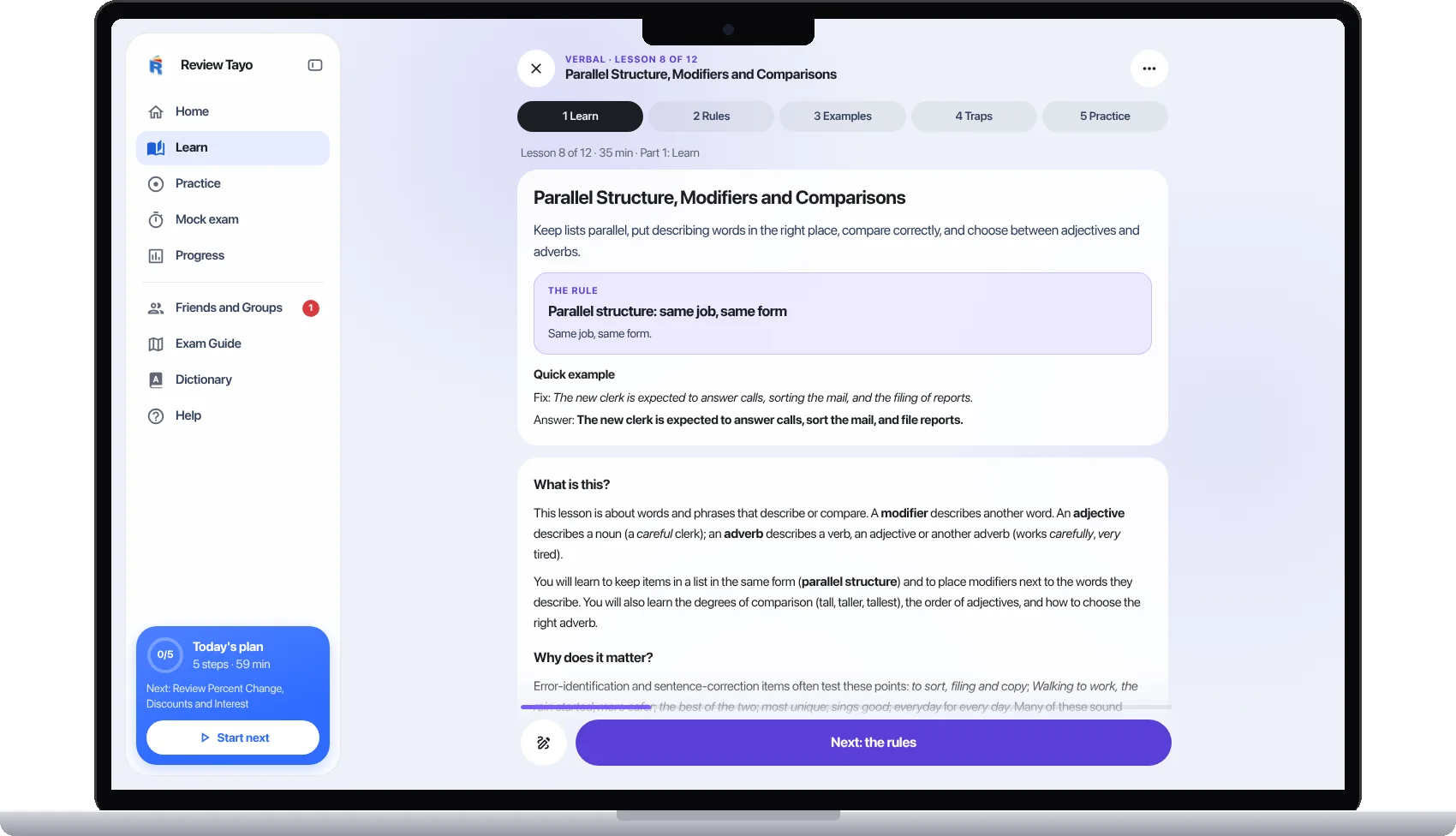

Not sure which topic to begin with? We covered that in what to study first, and the full list of topics is in what's on the exam.
Try it on one topic tonight
Pick one topic you have been memorizing. Find its rule, say it in one sentence, then answer ten questions with it. If you want to see how exam-style items look first, our sample questions have 20 with answers.
Every new ReviewTayo account gets 3 days of full access to try everything. After that it is a one-time payment from ₱99, with no subscription. Create your account and open your first lesson. Tara, Review Tayo!
Frequently asked questions
Do Civil Service Exam questions repeat?
Do not rely on it. The CSC does not release its past exams, so no one outside the Commission can confirm which items return. What repeats is the scope: the same subjects, topics and question types appear, with different sentences, numbers and choices.
Does the CSC release past Civil Service Exam questions?
No. The CSC does not publish its past exam papers or answer keys, and it says it does not make or sell review materials. Practice questions in reviewers are written by their authors to follow the scope.
Is memorizing a reviewer enough to pass the Civil Service Exam?
Usually not. Memorized answers stop working when a detail of the question changes. Learning the rule behind each topic lets you answer new versions of the same question type.
What should I memorize for the Civil Service Exam?
Mostly General Information: key provisions of the Constitution, R.A. 6713 and similar facts. Even there, organize the facts by structure, such as branch or article, so they are easier to keep.
Are reviewers with "actual exam questions" legitimate?
No. Possessing or using exam materials from an unauthorized source is cheating under Republic Act No. 9416. Treat any such claim as a warning sign about the seller.
Is the Civil Service Exam the same every year?
The format and subjects stay broadly the same, and the CSC announces the official scope for each exam. The individual questions are not something you can predict, so prepare for the topics, not for specific items.
Keep reading
How to review for the Civil Service Exam while working: a 30-minute daily plan
A realistic Civil Service Exam study plan for people with full-time jobs: 30 minutes on weekdays, one timed session on weekends, and what to study in each of the four months before exam day.
Study tipsWhat to study first for the Civil Service Exam (read this before you buy another PDF)
You have the official scope, a folder of reviewer PDFs and no idea where to begin. Here is what to study first for the Civil Service Exam, how to check if a reviewer is even current, and a clear order to follow.
Study tipsHow long should you review for the Civil Service Exam? The truth about "bukas na lang"
How long should you review for the Civil Service Exam? About four months at 30 minutes a day, by our estimate. See the math, what changes if you have less time, and how to stop saying "bukas na lang".