

Can you define these 12 words? Most Civil Service examinees just guess
"The meticulous auditor gave a candid report: the perfunctory inspections had only exacerbated the problem, and one more ambiguous memo would not mitigate it." Be honest. You read that twice, and at least one of those words you only sort of know. Those six are typical Civil Service Exam vocabulary words, and "sort of" is exactly how points are lost.
Now try it in Filipino
Akala mo mas madali dahil sariling wika? Sige.
Sa kabila ng hapis at himutok, hindi alintana ng mga maralita ang karimlan, basta't walang huwad na pangako.
You speak Filipino every day and you probably still slowed down. Nobody says karimlan at the sari-sari store. Verbal Ability has items in both English and Filipino, and the Filipino words are the deep kind, hindi pang-araw-araw.
So that is twelve words. Count how many you could define out loud, without the sentence helping you. Then check.
The 12 words, with meanings
English
| Word | Meaning | Para matandaan |
|---|---|---|
| meticulous | showing great attention to detail | Metikuloso: sobrang maingat sa detalye. Hindi ito "mabagal" |
| candid | truthful and straightforward | Candid photo, hindi naka-pose. Ang candid na tao ay prangka at tapat |
| perfunctory | carried out with minimum effort | Pakitang-tao lang, ginawa nang walang gana |
| exacerbate | to make worse | Kinamot mo ang kagat ng lamok, lalo itong lumala |
| ambiguous | open to more than one interpretation | Ambi means both ways: malabo dahil maraming puwedeng kahulugan |
| mitigate | to make less severe | Disaster mitigation: bawasan ang tindi ng pinsala |
Filipino
| Salita | Kahulugan | Kasalungat |
|---|---|---|
| hapis | lungkot; dalamhati | galak |
| himutok | hinaing; sama ng loob | kasiyahan |
| alintana | pansin; pag-aalala | pagwawalang-bahala |
| maralita | mahirap | mayaman |
| karimlan | kadiliman | liwanag |
| huwad | peke; hindi tunay | tunay |
Ten or more: you read a lot, and it shows. Six to nine: normal, and very fixable. Five or fewer: also normal, and now you know where some easy points are hiding.
How vocabulary shows up in the exam
It is not only the items that ask for a meaning. Words decide much more of Verbal Ability than people expect.
- Word meaning. A word, often in capital letters inside a sentence, and you choose what it means.
- Sentence completion. You pick the word that fits the blank. If two of the choices are strangers to you, it is a coin toss.
- Word analogy, in Analytical Ability. You cannot find the relationship between two words if you do not know one of them.
- Reading comprehension. One unknown word in the question can change which answer looks right.
The full list of topics is in what's on the exam. The CSC does not publish a word list, so anybody selling "the official vocabulary list" is selling a guess.
Hoping the words are familiar is not a plan
The person who built ReviewTayo did not prepare for vocabulary at all before his earlier attempts. Not a list, not a flashcard. The plan was to hope the words would be ones he already knew.
Some were. For the rest, in English and in Filipino, he did what everyone does: picked the choice that "sounded right" and moved on. A few guesses land. Most do not, and a guess teaches you nothing for the next item. He took the exam twice without passing.
The opposite mistake does not work either. Memorizing a list of five hundred words in the last two weeks feels serious, and almost none of it is still there on exam morning.
Three things that make a word stay
1. Get quizzed, and be wrong once
Reading a meaning is passive. Having to choose, and choosing wrong, is what makes your brain keep the word. Try one.
The rain finally ABATED by noon. ABATED most nearly means:
A. started B. worsened C. weakened D. spread E. returned
Show the answer
C. weakened. To abate is to become less intense. It is said of storms, pain or anger that slowly lose strength.
2. See it in a sentence
A definition tells you what a word means. A sentence tells you how it behaves. Compare "carried out with minimum effort" with this: The guard gave the bags only a perfunctory glance, barely checking them before waving people through. You will remember the guard.
3. Learn the parts, and get several words at once
Many English words are built from pieces. Learn a piece and you can work out words you have never seen.
- bene means good: benevolent (well-meaning and kindly), benefit, benefactor.
- mal means bad: malicious (intending to do harm), malevolent (wishing evil on others), malpractice.
- ambi means both: ambiguous, ambidextrous.
Tandaan: mal = masama, bene = mabuti. That one line can settle an item on its own.
Watch out for look-alike pairs
The exam likes words that are close but not the same. Abate and mitigate both involve "less", but a storm abates by itself, while a person mitigates damage by doing something. If both are in the choices, that difference is the whole question.
Bonus: three sawikain you should not take literally
- ningas-kugon: masigasig lamang sa simula. Like a review plan that lasts until Wednesday.
- balat-sibuyas: maramdamin; madaling masaktan.
- nagbibilang ng poste: walang trabaho. Not an inventory job at Meralco.
Idioms like these, in Filipino and in English, are worth a few minutes a week. They are quick to learn and impossible to guess.
A dictionary built for the exam
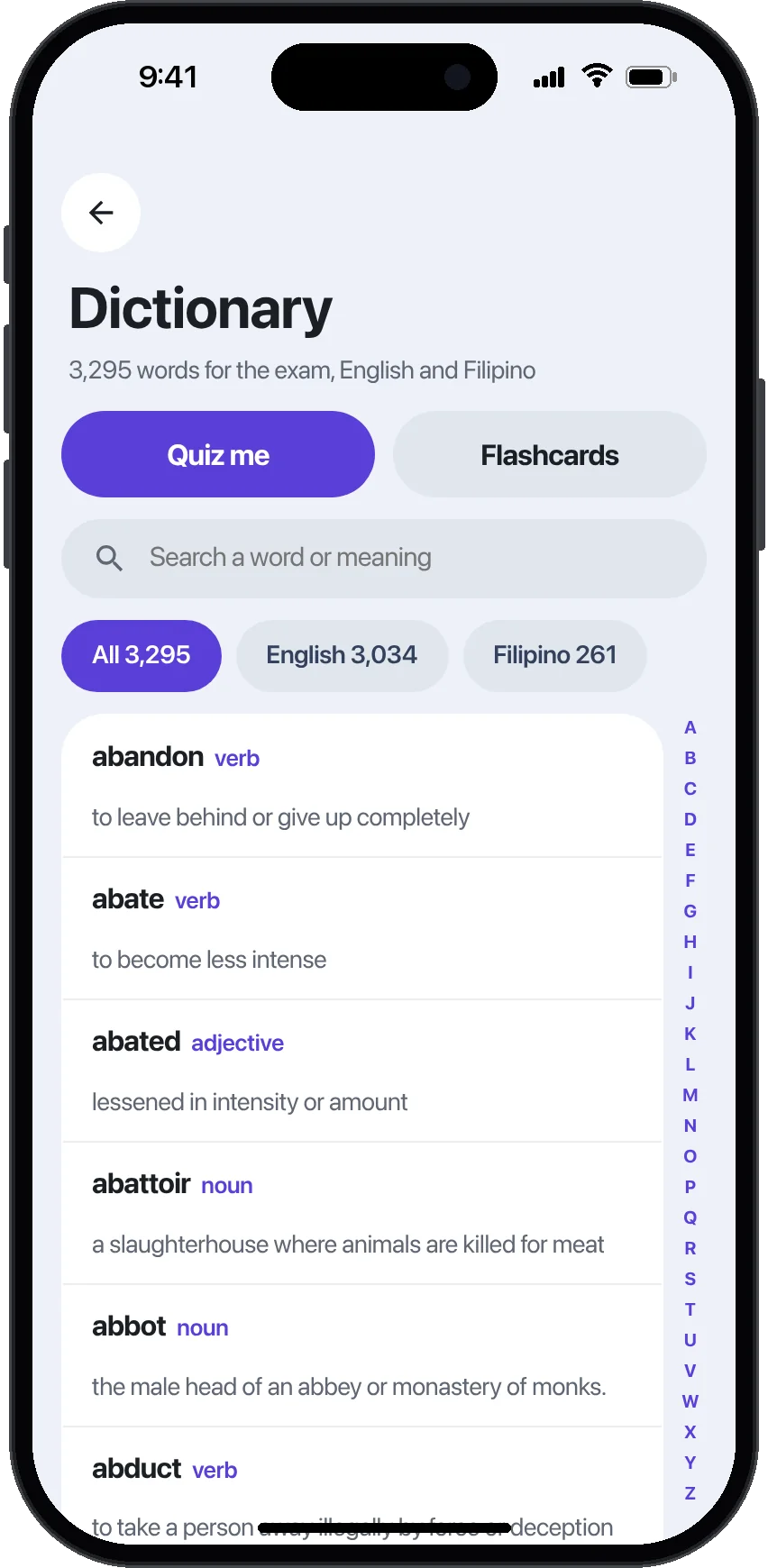
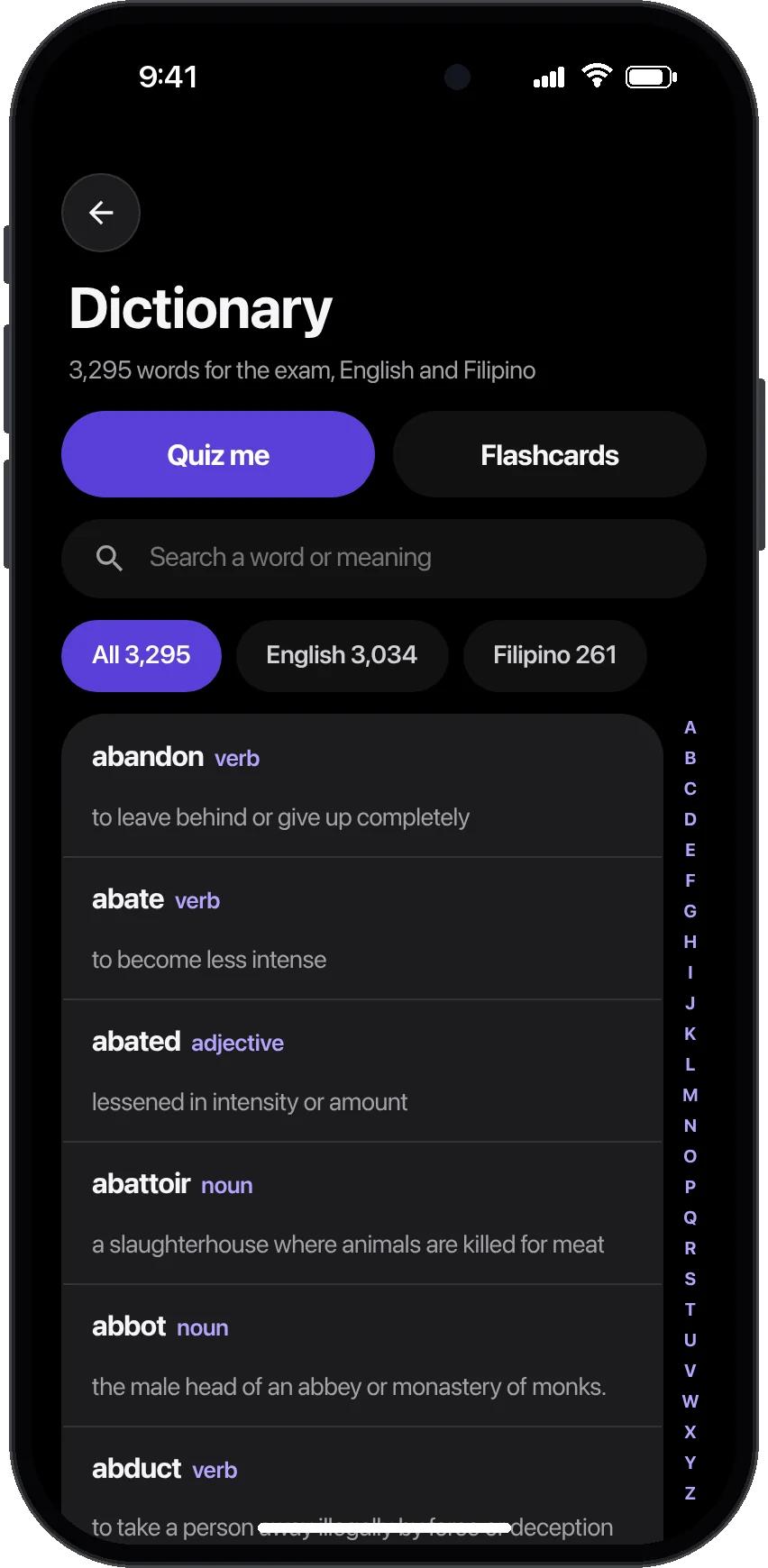
ReviewTayo has its own dictionary of 3,295 words for the exam, in English and Filipino, taken from the kinds of words that appear in word meaning, analogy and spelling items.
- Search any word or meaning the moment you meet it.
- Quiz me turns the list into the multiple-choice practice from step 1.
- Flashcards for a few minutes a day.
- Examples and memory tips for the trickier words, including the Taglish ones in the table above.
Five words a day is enough
Five words a day, quizzed and seen in a sentence, is thirty-five a week. Over a few months that is hundreds of words you actually own, which beats a list of five hundred you once looked at. It fits inside the 30 minutes in our daily plan, and if you are still deciding where to begin, read what to study first.
Every new ReviewTayo account gets 3 days of full access to try everything. After that it is a one-time payment from ₱99, with no subscription. Create your account and tap Quiz me. Tara, Review Tayo!
Frequently asked questions
What vocabulary words are in the Civil Service Exam?
The CSC does not publish a word list. Expect formal English words used in offices and reports, such as mitigate, candid and ambiguous, and deep Filipino words such as hapis, karimlan and huwad.
Is there Filipino vocabulary in the Civil Service Exam?
Yes. Verbal Ability has items in both English and Filipino, including word meaning. The Filipino words are often formal or literary ones that are not used in everyday conversation.
How can I improve my vocabulary for the Civil Service Exam?
Learn a few words every day. Quiz yourself on them, read each one in a sentence, and learn common word parts such as bene (good) and mal (bad) so you can work out unfamiliar words.
How do I answer a word meaning question if I do not know the word?
Use the sentence around it, look for word parts you recognize, and remove choices that do not fit the tone of the sentence. Then choose. There is no deduction for a wrong answer.
How many words should I memorize for the Civil Service Exam?
There is no set number. A steady five words a day, properly learned, is more useful than cramming a long list in the last two weeks.
Are idioms and sawikain part of the Civil Service Exam?
Idiomatic expressions in English and Filipino can appear in Verbal Ability items, so it helps to know the common ones. Their meanings usually cannot be guessed from the words themselves.
Keep reading
How to review for the Civil Service Exam while working: a 30-minute daily plan
A realistic Civil Service Exam study plan for people with full-time jobs: 30 minutes on weekdays, one timed session on weekends, and what to study in each of the four months before exam day.
Study tipsWhat to study first for the Civil Service Exam (read this before you buy another PDF)
You have the official scope, a folder of reviewer PDFs and no idea where to begin. Here is what to study first for the Civil Service Exam, how to check if a reviewer is even current, and a clear order to follow.
Study tipsDo Civil Service Exam questions repeat? The honest answer, and why memorizing your reviewer fails
Do Civil Service Exam questions repeat from past exams and reviewers? What actually comes back, why memorized answers collapse when one detail changes, and how to learn the rules that answer every version.