

Successive discount problems with solutions: the "25% off plus 10% off" trap
Here is one of the most common successive discount problems in Numerical Ability, solved slowly and then with the shortcut. Calculators are not allowed in the Civil Service Exam, so the shortcut is the whole point. Sale season counts as review, by the way.
The question
A jacket is marked ₱1,200. A store takes 25% off, then gives an additional 10% off the sale price at the counter. How much do you pay?
A. ₱780 B. ₱800 C. ₱810 D. ₱840 E. ₱900
Pick your answer before you scroll. Kahit hula.
The trap: adding the discounts
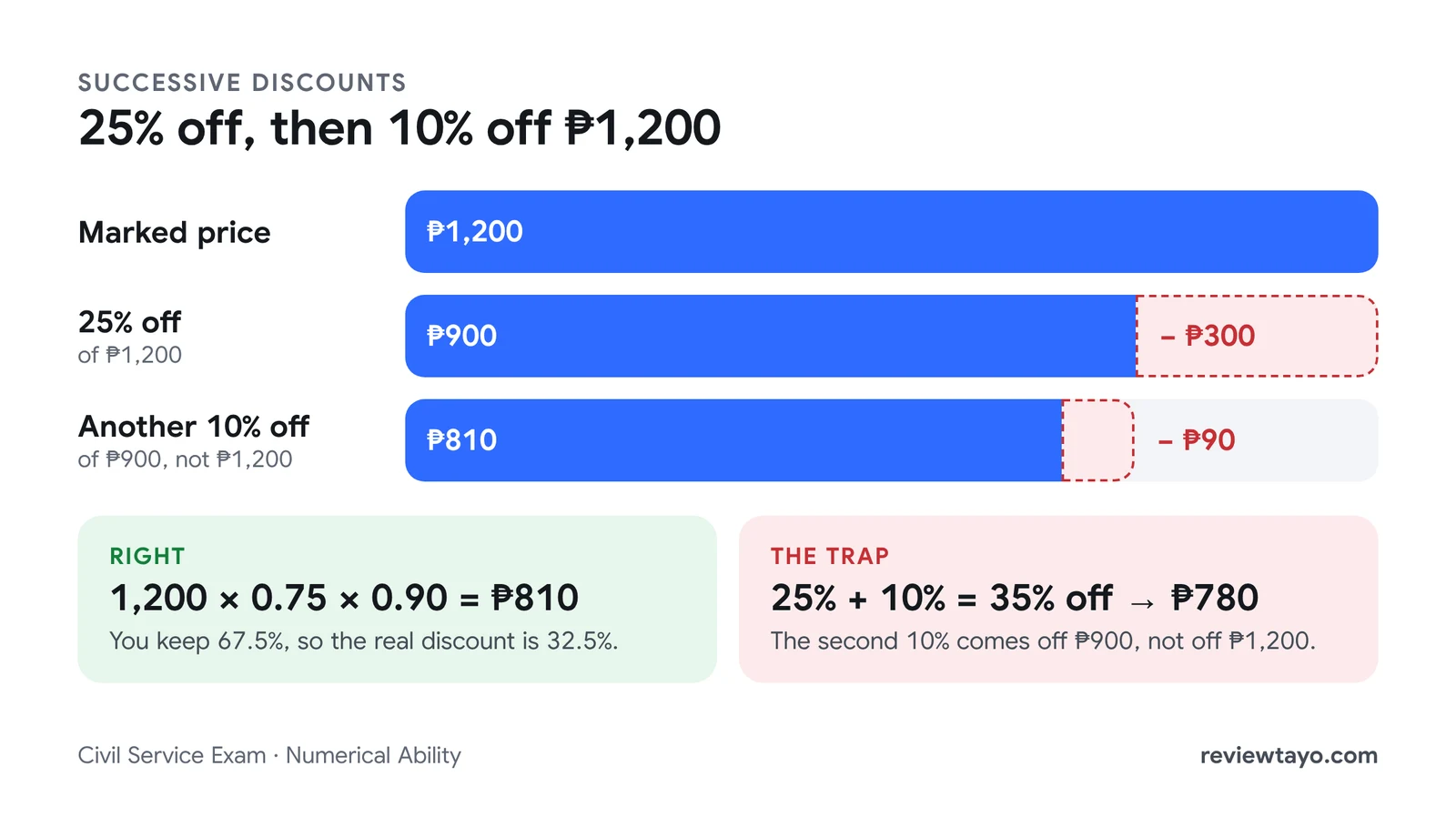
Most people add 25% and 10%, get 35%, take 35% off ₱1,200 and land on ₱780. That is choice A, and it is sitting there on purpose.
It is wrong because the second discount is not taken from the original price. The 10% comes off the sale price, which is already smaller, so that 10% is worth fewer pesos than 10% of ₱1,200.
The slow, safe way
- 25% of ₱1,200 is ₱300. The sale price is ₱1,200 − ₱300 = ₱900.
- 10% of ₱900 is ₱90. You pay ₱900 − ₱90 = ₱810.
The answer is C. ₱810.
Why the others are wrong: A (₱780) adds the discounts. E (₱900) stops after the first discount. B (₱800) and D (₱840) are close numbers placed to catch a rushed subtraction.
The shortcut: multiply what is left
After 25% off you keep 75% of the price. After 10% off you keep 90% of that. So:
₱1,200 × 0.75 × 0.90
Do the easy one first: 0.75 × 0.90 = 0.675. Or go in two small steps, which is friendlier without a calculator: three-fourths of 1,200 is 900, and nine-tenths of 900 is 810.
Two more things worth remembering:
- The order does not matter. 10% off then 25% off gives the same ₱810, because multiplication does not care about order.
- The real total discount is 32.5%, not 35%. You kept 67.5% of the price. Two successive discounts are always a little less than their sum.
Three more to try
- A ₱2,000 phone case bundle is 20% off, then another 5% off. What is the final price?
- A ₱500 shirt is 10% off, then another 10% off. What is the final price?
- An item is 50% off, then another 20% off. What single discount is that equal to?
Show the answers
1. 2,000 × 0.80 = 1,600; 1,600 × 0.95 = ₱1,520.
2. 500 × 0.90 = 450; 450 × 0.90 = ₱405 (not ₱400).
3. 0.50 × 0.80 = 0.40 kept, so it is a single 60% discount (not 70%).
Want more like this? Our sample questions guide has 20 questions with answers across the subjects, and the full lesson is Percent Change, Discounts and Interest.
Every question, explained like this
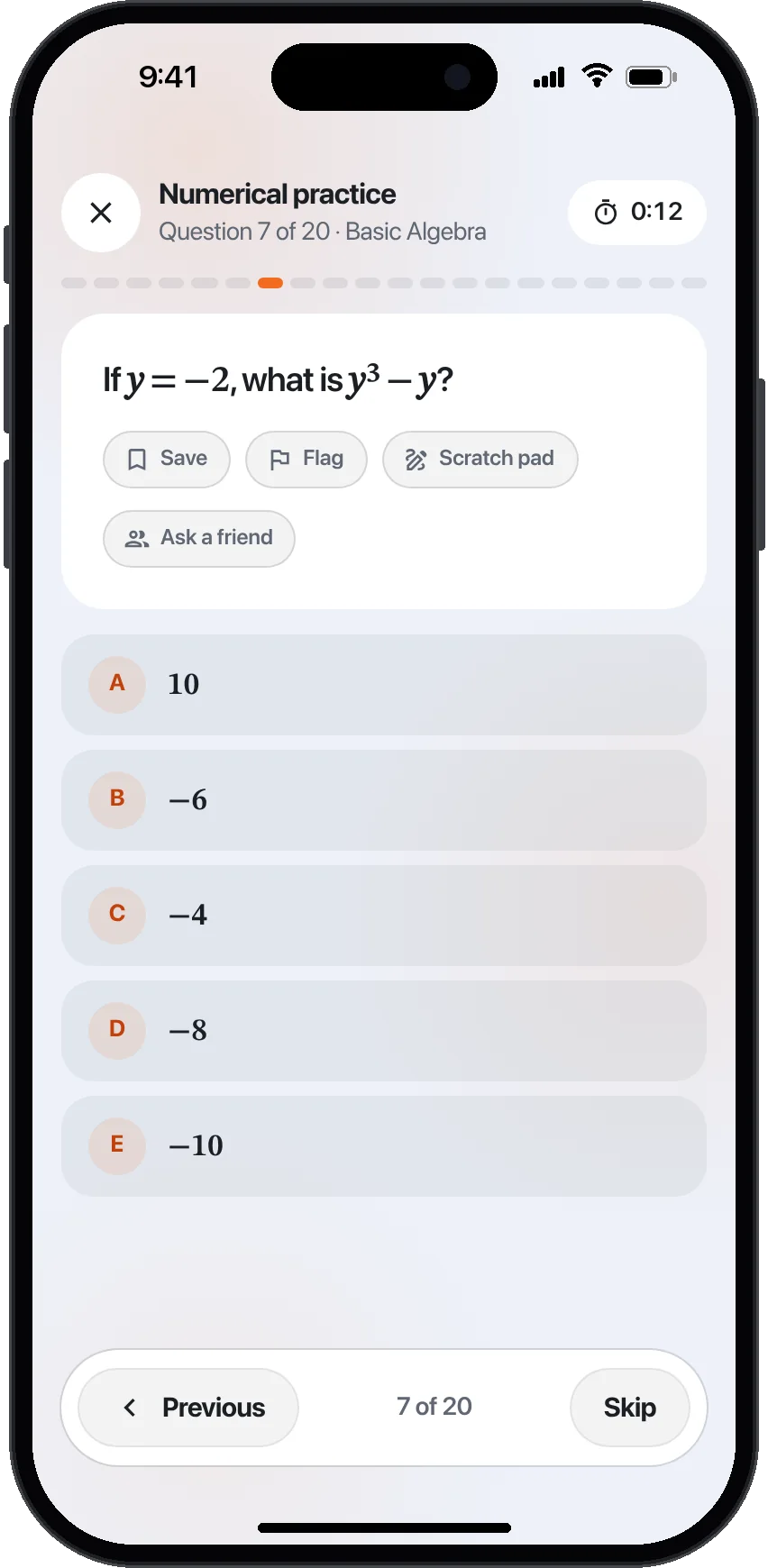
In ReviewTayo, each practice question comes with this kind of explanation: the right choice, why each of the others is wrong, and the shortcut. That is how one question teaches you the next twenty.
New accounts get 3 days of full access. Create your account and try today's set, or see what Numerical Ability covers first.
Frequently asked questions
Is 25% off plus 10% off the same as 35% off?
No. The second discount is taken from the already reduced price, so the total is 32.5% off. Multiply what is left: 0.75 × 0.90 = 0.675 of the original price.
How do you solve successive discounts without a calculator?
Turn each discount into what you keep (25% off means keep three-fourths), then take them one at a time. Three-fourths of 1,200 is 900, and nine-tenths of 900 is 810.
Does the order of the discounts matter?
No. 25% then 10% gives the same final price as 10% then 25%, because you are multiplying the same numbers.
Are calculators allowed in the Civil Service Exam?
No. That is why shortcuts with fractions and easy multiplications matter for Numerical Ability.
Keep reading
No calculator allowed: 7 math shortcuts for the Civil Service Exam (with step-by-step solutions)
Calculators are not allowed in the Civil Service Exam. These 7 Civil Service Exam math shortcuts, each with a worked example, help you solve Numerical Ability items by hand in under a minute.
Worked examplesNumber series in the Civil Service Exam: the patterns that solve most items, with worked answers
Number series in the Civil Service Exam follow a small set of patterns. Learn the 8 most common ones, a 3-step method to spot them fast, and try 6 practice items with worked answers.
Worked examplesCivil Service Exam grammar: the errors that cost the most points and how to spot them
Civil Service Exam grammar comes down to a short list of errors. Learn the 8 that appear across the most item types, a quick check for each, and try 8 identifying-error items with answers.