

Job order pa rin? How to get your civil service eligibility while working in government
You know the office better than the new hires. You train them, even. But when a permanent item opens, the first thing HR asks for is the one paper you do not have: your civil service eligibility. This post is for you.
The paper that keeps getting in the way
Here is the usual story. You have been in the agency for years as job order, contract of service or casual. Your evaluations are fine. Everybody knows you can do the work. Then a plantilla position opens, and the list of requirements has a line that ends the conversation: appropriate civil service eligibility.
It is not personal. For most permanent positions in the career service, the eligibility is a basic requirement, together with the education, experience and training the position asks for. No eligibility, no permanent appointment, however good you are at the job.
The frustrating part is that the exam is not about your job. Nobody in your office solves number series for a living. So people who are excellent at work sit the Civil Service Exam, miss the 80.00 passing rating, and start to believe they are just "not exam people". Usually the real problem is simpler: they never had the time or a plan.
One honest note before we go on. Passing the exam does not create a vacant item, and it does not promise you the position. What it does is remove the one requirement that disqualifies you before anyone even looks at your record.
Which level do you need?
There are two levels, and both need a general rating of 80.00.
- Professional covers first- and second-level positions: technical, administrative and supervisory jobs that usually need a college degree.
- Sub-Professional covers first-level positions only: clerical, trades, crafts and custodial work.
If you are not sure what level your target position is, ask your HR office or read the job posting. When in doubt, aim for Professional, because it can be used for first-level positions too. Our guide on Professional vs Sub-Professional has the full comparison.
Also worth one question to HR or the CSC: there are other ways to be eligible besides the exam, such as passing the bar or a board exam, or graduating with Latin honors. If one of those already applies to you, you may not need this exam at all.
How hard is it, honestly?
In March 2026, 48,735 passed out of 307,489 examinees: 15.85%. In August 2026 the reported rate was 14.41%. That is about 1 in 7.
Read that number the right way. It does not say the exam is impossible. It says most people walk in under-prepared, and a full-time job is the most common reason. The exam is long (170 items in 3 hours 10 minutes for Professional), timed, and it covers Verbal, Numerical and Analytical Ability plus General Information. You cannot cram that in the week before, lalo na kung may overtime.
The good news: there is no curve and no quota. Everyone who reaches 80.00 passes. You are not competing with the fresh graduates in the next row. You are only trying to reach a fixed line. More on that in passing score and results.
Ten years in? You may have up to 10 points waiting
Many long-serving workers have never heard of this, so read it twice. The CSC has a Career Service Eligibility - Preference Rating (CSE-PR) for job order, contract of service, casual, contractual and coterminous workers. If you qualify, up to 10 points can be added to a rating that fell just short.
- At least 10 years of government service as job order, contract of service, casual, contractual or coterminous.
- A performance rating of Very Satisfactory or its equivalent in your two most recent rating periods.
- You took the Professional or Sub-Professional exam on or after March 3, 2024.
- Your general rating was from 70.00 to 79.99.
The points only bring a rating in that range up to the 80.00 passing mark, and you have to apply for them: the CSC says the application must be filed within six months from the release of the exam results.
So for you the target changes a little. You still review for 80.00, but a 70-something is no longer a dead end. It also means every point counts double, because a 69 gets nothing and a 70 can get you there.
Check before you count on it. This comes from CSC Resolution No. 2301123 (December 7, 2023). Rules like this can be amended, and your service record has to support the claim, so confirm the current requirements with your HR office or the CSC.
How ReviewTayo fits around a full-time job
ReviewTayo was started by a working reviewer who took the Civil Service Exam twice without passing, with an unpredictable schedule, no time for a review center and no clear plan. It is the reviewer he wished he had, so it is built around the same problems you have.
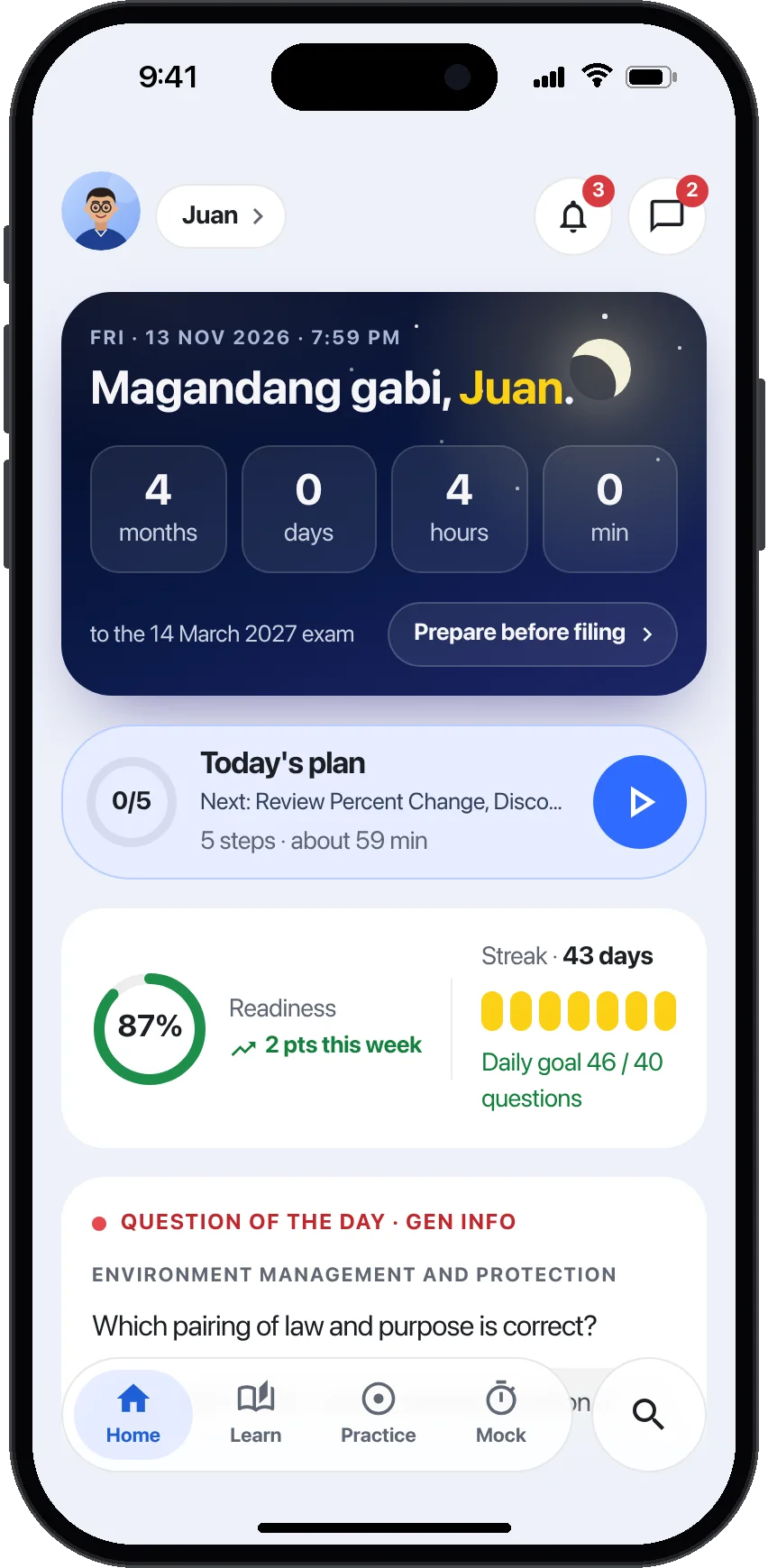
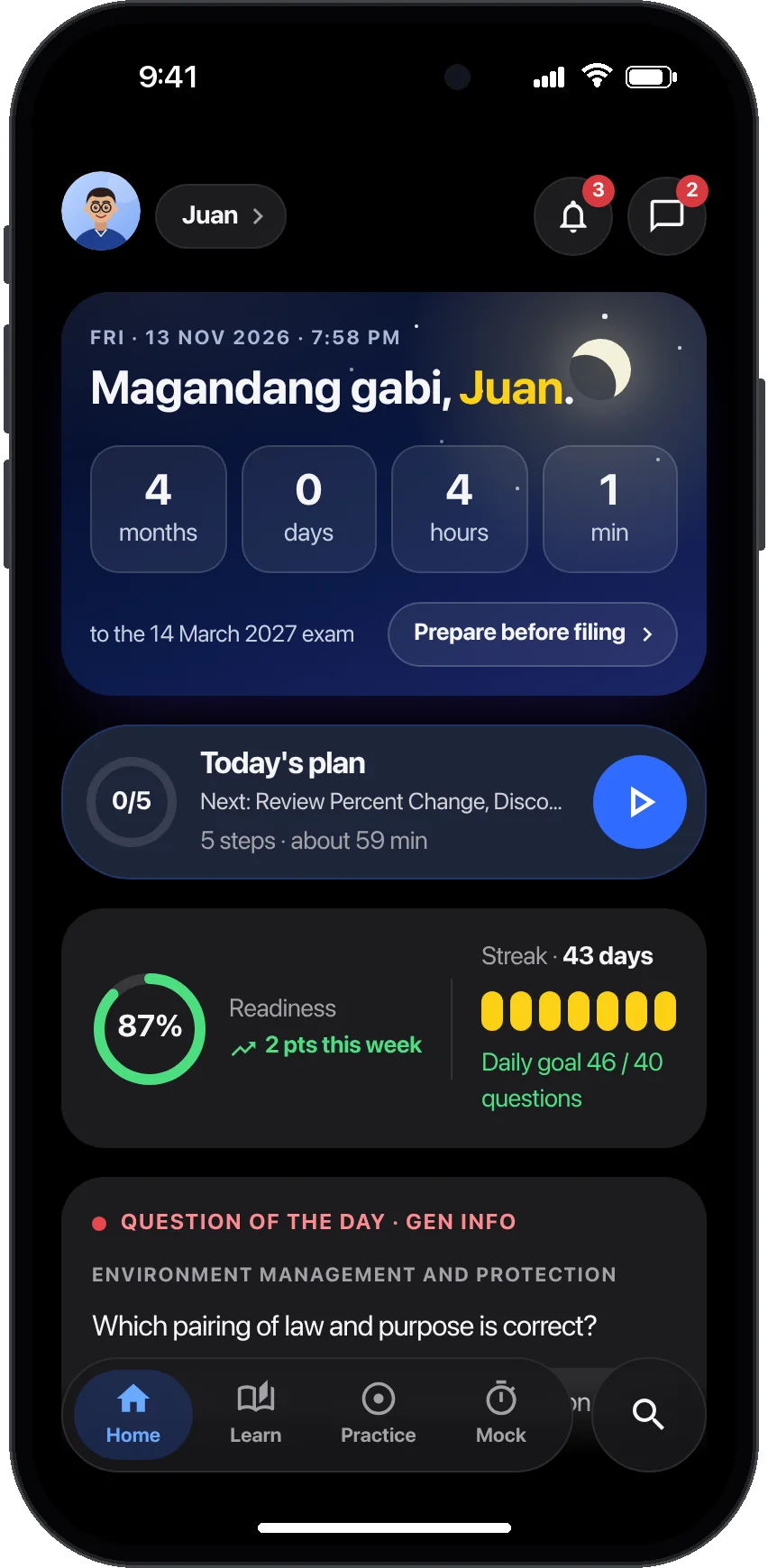
A daily plan made for you
Open the app and it tells you what to do today: which lesson to read, which mistakes to fix, how many questions to answer, and about how long it will take. You do not spend your only 30 minutes deciding what to study.
Lessons that follow the exam scope
The lessons go subject by subject through the official scope of the 2027 exam: rules, worked examples and the common mistakes. No padding, and nothing that will not be asked.
Explanations that teach you how to answer
This is the part most reviewers skip. Every practice question explains why the right choice is right and why each of the others is wrong, with drawings or tables where they help. Knowing that the answer is C teaches you one item. Knowing how to get to C teaches you the next twenty.
Short sessions, on your phone
It runs in the browser on your phone, tablet or computer and keeps working offline, so a jeepney ride, a lunch break or the 20 minutes before the flag ceremony all count. There are timed mock exams for the weekends, and a mistakes notebook that brings back what you got wrong until you get it right.
What to do this week
- Know your exam date. The next exam is on March 14, 2027. If you have a slot for it, your review starts now. If you did not get one, the exam after that is on August 8, 2027, with filing from May 10, 2027. Slots are first come, first served, so file on the first days. See the exam schedule and how to apply.
- Find your weak subject. Take the 15-question diagnostic. It takes a few minutes and shows where your points are hiding.
- Start small and daily. Thirty minutes a day beats one heroic Sunday. We wrote a full plan for that: how to review while working.
Every new ReviewTayo account gets 3 days of full access to try everything. After that it is a one-time payment from ₱99, with no subscription. Create your account and do today's plan. Kaya mo 'yan. Tara, Review Tayo!
Frequently asked questions
Can a job order or contract of service worker take the Civil Service Exam?
Yes. The exam is open to Filipino citizens who are at least 18 years old and meet the CSC’s requirements, whatever your current employment status. Check the full list on our requirements guide.
Does passing the Civil Service Exam make me permanent?
No. Passing gives you the eligibility. A permanent appointment still needs a vacant position and the education, experience and training that position requires. The eligibility removes the requirement that most often blocks long-serving workers.
Should I take Professional or Sub-Professional?
Take the level your target position needs. Professional covers first- and second-level positions; Sub-Professional covers first-level only. If you are unsure, aim for Professional.
How long should I review if I work full time?
Start as early as you can. About four months of short daily sessions, with a longer session on weekends for timed mock exams, is a realistic plan for a working reviewer.
What is the CSE-PR for job order and contract of service workers?
It is the Career Service Eligibility - Preference Rating. Workers with at least 10 years of government service as job order, contract of service, casual, contractual or coterminous, and a Very Satisfactory rating in their two latest rating periods, can apply to have up to 10 points added to a general rating of 70.00 to 79.99, for exams taken from March 3, 2024.
Is there another way to get eligibility without the exam?
There are special eligibilities, for example for bar and board passers and for honor graduates. Ask your HR office or the CSC whether one applies to you before you file.
Keep reading
Failed the Civil Service Exam? What to do before your next take
Did not pass the Civil Service Exam? You are in the majority, not the minority. What the numbers really say, the three-month rule for retakes, and a calmer, smarter plan for the next exam.
StoriesCivil Service Exam group study: the night everyone said "Ahhh, ganun pala 'yon!"
How a Civil Service Exam group study keeps working people reviewing: same questions, a voice call, answers hidden until time is up, then a discussion and a podium. A real barkada, step by step with screenshots.
Study tipsHow to review for the Civil Service Exam while working: a 30-minute daily plan
A realistic Civil Service Exam study plan for people with full-time jobs: 30 minutes on weekdays, one timed session on weekends, and what to study in each of the four months before exam day.